19 December 2011
One Man Nation - A Singaporean Artist in Exile, An Interview
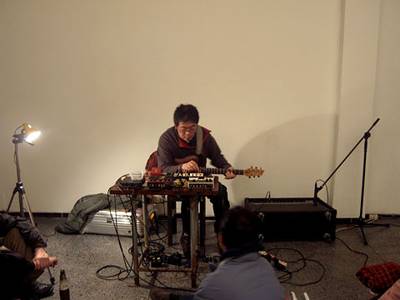
In early November 2011, I met up with Marc, the man behind the project One Man Nation for a chat. So far One Man Nation has released an LP on Austrian record label, Moozak last year, entitled SUSPENDED IN A VORTEX IN THE MIDDLE OF A BOWL FROM TIBET / WHEN I WAS YOUNG I WAS EASILY AMUSED, BUT NOW IT IS ALL, THE SAME. AND THE SAME.... His album refuses to be pigeonholed conveniently, call it experimental, avant-garde, electronic or sound art, it is one and all of those adjectives listed.
The session started with a question on his personal musical path; to Marc, the discovery of the computer as a tool was a pivotal moment but it did not happen immediately thereafter. He traced the genealogy of his musical development as followed:
2003 – punk music with straight-ahead guitar
2004 – beginning of the use of a computer, but with guitar added
2005 onwards – more full-on use of computer, and he has used the similar setup since then, with a conscious emphasis to make sure that things do not get too techie, as to him, the music and the performance are much more important.
Marc never stopped stressing the power and significance of the collective creative experience with other musicians and artists in his creative journey thus far, as to him each collaboration goes beyond mere interaction and communication but it is about the sharing of the moment between the parties involved. He could not highlight enough that to him, he does not want to just play music but to him, the entire experience of musical creation and immersion is more than the current neo-liberal belief that all arts are just essentially entertainment and nothing more. On the other hand, he does not want to fall into the trappings of the other end of the spectrum, which is elevating what he does into something on the pedestal, i.e. high-brow academic platitudes/museum and art gallery fodder. He is always drawing what he does as a form of a continuation of the punk spirit which brought him into music and the arts in the first place. It is about breaking socially dictated norms and more vitally, breaking the artificial bourgeois spotlight placed on the spectacle of musical presentation/performance.
[One Man Nation] Tour in Bali + Lombok (Apr 2010) from transitoracle on Vimeo.
We moved on to talk at length about experimental art; we both agreed that it should be about breaking away from the many stifling cultural norms –all artistic and musical experiences should not just be spectators standing there to watch but instead both the artist and the audience ought to be involved in the shared immersive trip, and Marc mentioned a possible shamanic one but yet there should not be an invisible hierarchically-defined line between the person expressing & the people responding.
Naturally we also talked about the earlier proponents of experimental art like dada & Fluxus, which foregrounded innovation and breaking away from cultural/dogmatic confines, as opposed to the institutionalisation of the “experimental art” today. It must be about pushing forth the process as well as the creative intentions of the artists and not something driven by careerist and opportunistic drivel so common found today.
We then returned to review about Marc’s personal intentions behind his art thus far. When probed, he stated flatly that he sees no difference between what he does in his solo work as one man nation and his many varied collaboration with other artists. I then asked for an epiphanic account from Marc of a very exceptional collaborative work that he could share. He brought up Truna, a Spanish musician, whom he has an Improv duo with. The form might be nominally punk but it has been a fulfilling collaboration for the parties so far as it was like an artistic and creative conversation during their performances, a venture which is very different from One Man Nation solo project.
Spared from the type of state persecution underwent by many older Singaporean artist, Marc has been globe-trotting to Rotterdam, India, Indonesia and Spain (currently he maintains a residence in Spain, Granada but he is usually not there most of the time), and he is also focusing more on The Unifiedfield, an artists-run organisation which the Wire magazine featured in its Global Ear series last year. I thus tried to source out the provenance of his current nomadic lifestyle. Without batting an eyelid, he confirmed my suspicions that he had always wanted to leave Singapore as a child, and he has not found a way to remain here and thus he simply cannot see himself staying in Singapore and he grabbed the first chance he could to follow his wanderlust.
Thus, after the mandatory military conscription duty here, he left to tour, not the typical packaged style of course, but punkish, DIY way around Asia in 2003 and thereafter to Europe since then. He does not see much here in Singapore. It is not so much that he is totally rootless but he up-fronted his strong disdain for the general conformist and materialist mentality. We concurred that the whole society in Singapore is in general not made for individual discourse as the overall structure is stringently top-down and media dictated (which is closely monitored by the state as well), the dreary day-job situation to support the materialistic wants and he was bemused by the local grant-doling institutions for having a very narrow mind-set in their relentless search for sponsoring and supporting artists and art forms/projects here which have to have a prominent Singaporean agenda/front to them. He feels that the local arts administrators are still not very well-versed in the fields of art and Singapore despite its claim for the being the top in many areas, the arts is one glaring gap which must be seriously looked into.
However we also agreed that in Singapore even the arts is largely about the economics which sad to say we really cannot judge based on monetary basis; either that many Singaporeans just follow a well-trodden path that everyone is going down on. Perhaps it is due to the state of Singapore that it is in: the solid security of it all and the hyper planned-out nature of our day-to-day (though the recent SMRT debacles proved otherwise). With all these in place, it can easily lead to general complacency amongst the populace and in turn, their thought processes are seriously affected. And if one would to apply the Maslow’s hierarchy of needs, we are not getting better here as Singapore, despite the prosperity (economic but not in other areas), we are in actual fact more enslaved to the entire system due to the high cost of living & the way and wants of most Singaporeans.
From politics we next turned back to the personal. Marc shared that his globe-trotting experience has shaped not just his musical but artistic self as even though creatively he is having some sort of a lull, but to him, art is life, life is art. One Man Nation is what he is, who he is and whatever he does daily.
I surfaced the recent acceptance and in fact active encouragement of the corporate world to promote the idea of creation and he feels that it is all about absorbing what they think is useful for them to help barf up their coffer at the end of the day. Business as usual, mate.
He then went on to talk about the importance of introspection in his daily life which is a very crucial process in his art. Seen by Marc as a process key to his personal existence, his intention to create is not the only thing out of this, but instead he is consuming life itself as the same time as it is about how he lives. He constantly reminds himself that he does not want his art-making to be tainted by commercial intentions and vanity. If there is money then it is collateral but definitely not the main thing. But he admitted that it has been a tightrope to balance to live & create, for whatever reasons he feels so far. It is not easy to live the way he is as it has no room for complacency, but the trade-off is that this instability which he faces daily makes him appreciate everything in life, which gives him the insight to treasure the moments in life.
Towards the end of the interview I asked him for an epiphany. And this is what he related to me:
He was playing with some dancers in Bilbao, at the Festival of Improvisation 2007, which annually invited both acoustic and electronic musicians, dancers and other artists to just come together to jam. At this festival, he was the nominal electronic musician with his computer and he was largely still in his “electronic musician” mind-set, as he wanted to match the “right” music/sounds to the setting. Then it suddenly hit him that he should just think beyond creating music but to instead feel the temperature in the room, sense the lighting, feel the size of space, connect with the people in the space, and more, as everything he was doing and was attempting to do in there was actually part and parcel of a synthetic fuse with the set and setting to create. He concluded that musicians who are usually too caught up in the conventional music-making procedure, very often fall into the trappings of the male patriarchal schema.
Finally when asked about the meaning behind his project, One Man Nation, he expressively stated that it is all about going beyond nation-state and nationality, to be in a world without any borders, in other words, to even go beyond international, but to be an outer-nationalist at the end of the day.
18 December 2011
Yan Jun in Singapore: An Interview
Interview with Yan Jun, 28 Oct 2011
I met Yan Jun, the renown sound artist, Noise practitioner, event organiser and all-round ideologue of the current Chinese experimental/avant-garde scene who came to Singapore and performed during the same Sonorous Festival (which Uchihashi Kazuhisa also performed at) organised by LaSalle School of the Arts in Singapore. The interview with Yan Jun was conducted in Chinese and so the following summary of our interview would definitely not be the truest representation of the interesting conversation which transpired between the two of us. There were still many issues which we wanted to discuss but due to time constraint we had to cut short the session and thus I am looking forward to chatting with Yan Jun again in the future if the opportunity arises.
We started the interview with a short chat on Yan Jun’s musical biography when he told me that he sees himself primarily as an event organiser; for the past six years, more than 300 performances were staged by him. On the average he has one gig going on per week, and for a particular six-month period, he actually had two gigs running on a weekly basis. The artists and performers, according to Yan Jun can be largely classified into about 50% Chinese and the other half from abroad. He still defines himself more as an event organiser and record label boss, releasing albums, and not as strictly an artist. He runs the Sub Jam/Kwanyin Records. He is mostly based in Beijing, China but he was awarded Asian Cultural Residency in New York in 2011so he was in NYC for some time as well.
When our conversation moved on to his ideas and concepts on sound art and noise, he became more animated and passionate as he began explaining to me his personal definition of such terms, terminologies and conceptual schema. He feels very strongly about the fact that, today, modern art is very dictated by the canon, conventions and history of western ideas and aesthetics; to him modern sound art or noise is not so much a genre but sound should be treated as a medium, a tool. Sound, noise & sound art should be divorced from their western roots and meanings in the new century when the world has become more globalised.
To him, sound art in recent years is very formalised, formulaic and predictable. If I did not get him too wrongly, sound art today is too academic and elevated to the status of high art which seems contradictory to the original intent of the pioneer practitioners. Noise and sound, in a very hygienic western world in contemporary times seems to need noise to create some form of contrast and source of opposition. This is very different from where he came from, China. He shared with me an anecdote about his own house back home: his house has no ground/earth wiring and thus so a lot of noises/sounds are emitted all around the residence and they sipped into his recordings whenever he does any home recording. Noise is intentionally forged but it is part of the landscape feeding into the artistic eco-system of him and perhaps, for some other artists from China too.
He went on to qualified that in China it is very noisy consistently, and just like on a daily basis when he eats he is also consuming a lot of toxin, the noise/sound pieces which he creates can be seen as a product of his input in all sense of the word.
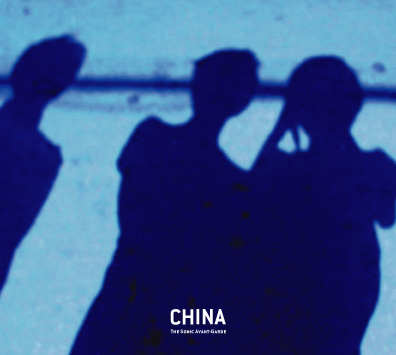
When I asked him if his ideas and understanding on noise/sound art is a shared one amongst the practitioners in China, he replied that it is more personal than anything else but he revealed that two other artists based in China today do have some mutual similarities in their personal aesthetical conceptions on their art and sound. One such artist is Yao Dajuin, who is actually from Taiwan but is based in China today. Yao is a key player in the Chinese avant-garde/sound scene today and his curated double CD album released on the record label, Post-Concrete, entitled, China – The Sonic Avantgarde, is a clear illustration of Yao’s personal vision of what he views sound art/noise as: field recordings, sound collages and sonic bites which totally rejects the high art, sound art in the museum/art gallery paradigm so fashionable and profitable for the more careerist ones in recent decades. Yao is more interested in the history of listening, auditory experiences and their psycho-social, psycho-geographical relationships than a nicely packaged tour in the white spaces of the halls of western cultural shrines.
The other kindred spriit of Yan Jun is Lin Qi Rui (I hope I got his name correctly, so if I did not do so please drop me a comment and let me know more about him, thanks!) –a Taiwanese noise/sound artist based in China who is very staunchly against the western cultural hegemony in the arts and music. Lin has just finished writing a book in Mandarin, to be published soon. With 800, 000 words in tow, it examines the history and lineage of sound/sound art/noise in the Chinese world.
We went on to discuss about the terminology of modern sound art in China and he hinted that they are perhaps just fads and names merely as before 2005, these activities were sweepingly branded as Noise but post-2005, Sound Art became the acceptable name instead. He did say that China today is maybe Taiwan in the past and thus given time, China would be able to mature and grow more as a site of sound/noise creativity in the near future. Yan Jun also shared that those interested in sound/noise seem to come from the lower classes and many of them are youths living in the urban centres who are, in most part, not connected with the traditional art forms. Yan speculates that Noise to them can be seen as a form of personal projection of their personal environs and place in China today.
We went on to discuss about the perennial search for modernism today. He stresses that even before the 1911 Revolution in China, the obsession with modernity was already there. Today, the Chinese artists are continuing the path towards the push towards modernism; whereas ten years ago, the buzzword was to be the avant-garde and earlier on, to rock was the predominant artistic goal, the mental and psychological desire to stretching the envelope remains, the same today. Many want to be more extreme, more modern and even more avant-garde than the west, where such ideas first germinated. Yan Jun gave the analogy of imitation and even later on iconoclasm as the modus operandi of many artists in China. He even mentioned that it is like a form of artistic devouring of the predecessors, to make these earlier aesthetic travellers part of their own. It should be seen as form of flattery and praise for those who have come before. Right now many in China are not very self-conscious about the entire process and thus it takes time for the Chinese artists to be more sensitive, more cruel and relentless to be, neither Western nor traditionally Chinese, a third path.
Before we were interrupted by the next performance during the night, we compared the western avant-gardist tradition to that of the current Chinese strain; where Dada, Surrealism and Fluxus were a very conscious break from the bourgeois western art world (just like when Yan Jun was in Zurich, the street where the Dadaists staged the Cabaret Voltaire, the main motivation force was to disrupt and upset the quietude and sterility of the place and Europe), in China, they do not need to do so due to the differences in the historical-cultural forces at play in China for the past century.
We ended our interview at this point but from what Yan Jun had discussed, we can perhaps glean better into the developing milieu of the increasingly Chinese-prominent century in the future.
15 December 2011
2011: The Year In Review
1. Label of the Year : Vinyl On Demand: Psychic TV with White Stains, German Punk & Wave Vol 1, Laibach, Ghedalia Tazartes, Club Moral, Grim
2. PAN: R/S, James Hoff, Heatsick, Tricoli/Ankersmit
3. Editions Mego: YasunaoTone, Bill Orcutt, Mika Vainio, Hecker, Russell Haswell, Mark McGuire
4. Blut Aus Nord - 777 sect(s)
5. Simon Reynolds - Retromania
6. Metalion
7. Ben Watson - Adorno For Revolutionaries
8. Sudden Infant: Noise In My Head
9. Spectrum Spools: Hive Mind, Driphouse
10. Skullflower
11. Psychic TV - Themes (Box)
12. Merzbow - Merzbient (Box)
13. Lou Reed & Metallica -Lulu
14. Andrew Chalk - Violin By Night
15. Christoph Heemann - Rings Of Saturn
16. Stare Case - Lose Today
17. To Live And Shave In L.A. - The Cortege
18. Ambarchi/Haino/O' Rourke - In A Flash Everything Comes Together
19. Prurient - Bermuda Drain
20. Album of the Year: Cut Hands - Afro Noise
2. PAN: R/S, James Hoff, Heatsick, Tricoli/Ankersmit
3. Editions Mego: YasunaoTone, Bill Orcutt, Mika Vainio, Hecker, Russell Haswell, Mark McGuire
4. Blut Aus Nord - 777 sect(s)
5. Simon Reynolds - Retromania
6. Metalion
7. Ben Watson - Adorno For Revolutionaries
8. Sudden Infant: Noise In My Head
9. Spectrum Spools: Hive Mind, Driphouse
10. Skullflower
11. Psychic TV - Themes (Box)
12. Merzbow - Merzbient (Box)
13. Lou Reed & Metallica -Lulu
14. Andrew Chalk - Violin By Night
15. Christoph Heemann - Rings Of Saturn
16. Stare Case - Lose Today
17. To Live And Shave In L.A. - The Cortege
18. Ambarchi/Haino/O' Rourke - In A Flash Everything Comes Together
19. Prurient - Bermuda Drain
20. Album of the Year: Cut Hands - Afro Noise
Uchihashi Kazuhisa from Altered States in Singapore - An Interview
Interview with Uchihashi Kazuhisa, 2011:
In the recent Sonorous Festival organised by Tim O’ Dwyer and Darren Moore at the DaSalle College of the Arts in Singapore, I had the rare opportunity to interview one of the key Japanese improvising stalwarts, Uchihashi Kazuhisa just before his performance. We talked briefly about the Improvised music scene in Japan as well as some of his personal thoughts on related subjects.
He first shared with me a short history of one of his most renown groups, Altered States. The group was established in 1990 and thus it has been an on-going enterprise of his for the past 21 years and from the sound of it, it is still going on strongly as Uchihashi Kazuhisa will be releasing the new album soon. He was also involved with Otomo Yoshihide in Yoshihide’s key group in the 1990s, Ground Zero for much of the group’s existence then. He also shared with me his ideas for Altered States; they started with a structure and gradually they moved into more improvised realms. The ultimate stage for the group would be playing in a totally improvised setting.
We then talked about the Improvised music scene in Japan in general. He commented that the scene saw its greatest share of fan base and support in the 1990s (we somehow have a common view that it was due partially to the interests shown by the western press during the same period of time). But he qualified that the fan base is always there regardless of musical trends and currents awashed in the music press.
He expressed his enthusiasm for new and younger musicians to emerge to meet and play with but he did admit that the newer musicians seem to appear from other genres like Noise and electronic music but not so much in the improvised music scene. When I mentioned about the Improvised Music From Japan scene he showed his dissatisfaction with the curatorship of the label as he felt that it is mainly the idea of one person and thus the name which he used does not justify the use of such a comprehensive term.
We ended off our conversation with a short discussion on his favourite Improvised music hero – Fred Frith (Henry Cow, Naked City and solo, just to name a few of Frith’s musical involvement). He felt that Fred Frith’s ability to move between the various musical forms and his improvisational skills are points which earned him his admiration.
Postscript I: Altered States are a great band to listen to on CD (sadly I still have not heard them live yet); but the music of the group is the best distillation of the less convoluted moments of Magma, Henry Cow’s looser instances but all blended together with the unique vision of Uchihashi Kazuhisa and co. to integrated avant rock form, improvised thought-process and basic raw power of modern music of the 20th century. They are music which sounds intellectual on paper but groovy, fun and genre-defining when heard through your speakers (yes real speakers so please no listening to it via phones and puny little earphones attached to your mp3 players).
Postscript II: I have very busy in recent months but currently I am in the process of transcribing another interview which I have conducted with another artist at the said festival as Uchihashi Kazuhisa - Yan Jun from China, as well as another interview which I have done with Marc of Singapore's very own One Man Nation. More coming up on the Review of 2011 and my recent trip to Japan where I caught Cut Hands, Incapacitants and Ramleh live in Tokyo. So watch this space!
Subscribe to:
Posts (Atom)